
News

Two Years of Inspiration: What Your Generosity Achieved Through the 2024 Inspirational Research Grants

Two years ago, thanks to the generosity of our philanthropic donors, TOGA awarded the first ever Inspirational Research Grants. Read their final achievements.

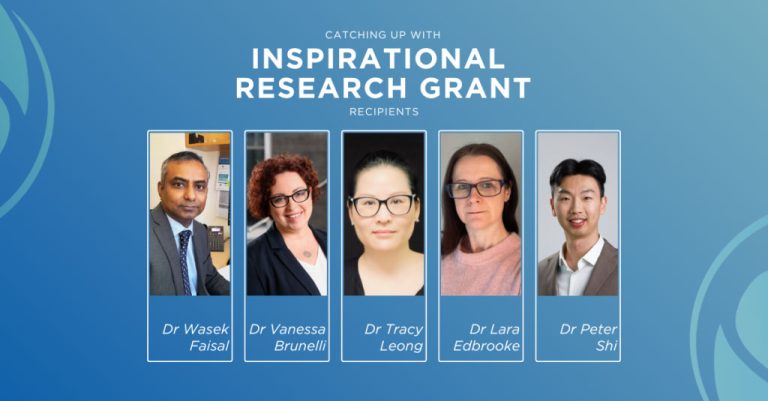
Two years ago, thanks to the generosity of our philanthropic donors, TOGA awarded the first ever Inspirational Research Grants. Five researchers each received $50,000 to turn an idea into real progress for people affected by thoracic cancers, from better ways to predict outcomes, to smarter ways to detect treatment resistance, to practical support that helps people breathe and prepare more easily.

That two-year journey is now coming to a close, and the results are inspiring. These projects have produced new tools, new collaborations, new presentations on national and international stages, and new funding that will carry the work well beyond the original grant. Every one of them was designed in consultation with consumers, and every one exists because of people like you.

Here is what your support has made possible: 

Dr Wasek Faisal: CARE, a Clinical Composite Score for Metastatic Lung Cancer

Dr Wasek Faisal

People living with lung cancer in regional and rural Australia face poorer outcomes than those in the cities. Dr Faisal set out to build a scoring system that helps clinicians and patients understand risk at the very beginning of the journey.

Research achievements:

The project delivered exactly what it set out to do. Drawing on a cohort of 300 patients, Dr Faisal’s team developed the CARE Score, a prognostic scoring system for wild-type, non-squamous, metastatic non-small cell lung cancer. They explored a wide range of clinical, demographic, tumour-specific and health service-related factors. For overall survival, three factors stood out: the TTF1 status of the tumour, the presence or absence of liver metastases, and ECOG performance status. For progression-free survival, the most influential factors were smoking status, liver metastases and ECOG.
The real strength of CARE is its simplicity. It uses information that is readily available at diagnosis, helping clinicians and patients to have meaningful conversations about prognosis from day one and to tailor treatment decisions accordingly.

Industry and translational opportunities:

Once peer reviewed and published, the CARE Score has the potential for regular use in everyday lung cancer care. To get it there, Dr Faisal is already in preliminary discussions with the Walter and Eliza Hall Institute of Medical Research (WEHI) about testing the score in the INHALE registry, a cohort of approximately 1,000 patients.

Future direction:

The next chapter is already underway. A validation study of the CARE Score, along with co-designed solutions to bridge the metropolitan and regional gap, is the logical next step. Neither was part of the original funded project, which makes this a powerful example of a TOGA grant opening the door to bigger things. Abstracts have been submitted to the 2026 Grampians Health Research and Innovation on the Run Symposium and the 2027 Australian Lung Cancer Conference, and a manuscript is being prepared for a major thoracic oncology journal.


Dr Tracy Leong: Uncovering Why Immunotherapy Stops Working

Dr Tracy Leong – Thoracic Oncology Group of Australasia (TOGA) Scientific Committee Member
Dr Tracy Leong

Immunotherapy has changed lung cancer treatment, but for many people the benefit does not last. Dr Leong’s project asks a crucial question: can a simple blood test tell us why?

Research achievements:

Using longitudinal blood samples collected through the TRACKER Biobank, the team investigated cell-free DNA (cfDNA) methylation, an epigenetic signal, using advanced liquid biopsy approaches. The findings support the potential of plasma cfDNA methylation profiling to identify biological features associated with treatment response and resistance.
The project has also built lasting capability. It established cfDNA methylation profiling workflows and generated preliminary data to support larger-scale liquid biopsy studies. It brought together investigators from the Olivia Newton-John Cancer Research Institute, University of Melbourne, Peter MacCallum Cancer Centre, La Trobe University, Austin Health, WEHI, Monash University, the Alfred Hospital and the Royal Melbourne Hospital.

The grant also supported the professional development of clinician and PhD candidate Dr Sarah Yeo, for whom the project forms an important part of her PhD research, and it supported meaningful consumer engagement. The work has been presented at the Australian Lung Cancer Conference 2025, the TOGA Annual Scientific Meeting 2026 and the World Conference on Lung Cancer 2026.

Future direction:

Final analyses are expected over the next two months. These will support validation of candidate findings and the development of a manuscript.

Dr Vanessa Brunelli: Making Breathlessness Management Usual Practice Research Fellow, University of Wollongong

Vanessa Brunelli – Thoracic Oncology Group of Australasia (TOGA) Scientific Committee Member
Dr Vanessa Brunelli

For many people with lung cancer, breathlessness is frightening and exhausting. Dr Brunelli’s BIG ISSUE project aims to make effective breathlessness management a standard part of lung cancer care. The depth of work completed across its workstreams is comparable to that of a PhD, and it formed the core of the PhD candidature of Jill Chen at the University of Sydney.

Research achievements:

An analysis of longitudinal data from the Palliative Care Outcomes Collaboration (PCOC) database revealed some striking findings:

  • 55.7% of people with lung cancer entering palliative care report breathlessness-related distress.
  • Breathlessness-related distress is strongly linked with distress from insomnia, fatigue and pain.
  • People who previously reported insomnia- or fatigue-related distress were more likely to report breathlessness-related distress later on. Those who previously reported pain-related distress were less likely to.
  • People over 65, those in metropolitan centres and English speakers were more likely to report breathlessness-related distress, and higher levels of it.

The team completed a systematic review of management strategies for lung cancer-related breathlessness. The work has been shared nationally and internationally. Jill Chen also won substantial Sydney Cancer Partners funding to visit the Wolfson Palliative Care Research Centre at the University of Hull and to attend the Helsinki congress, building international connections for the project.

Industry and translational opportunities:

The project is developing a stepped-care clinical pathway for breathlessness. A key opportunity is putting that pathway into real clinical settings through the research team’s networks. In parallel, Dr Brunelli will have completed audits of two large regional lung cancer outpatient clinics to identify where symptom management is best introduced across the patient journey. The pathway will then be implemented and evaluated in those clinics so that breathlessness is addressed routinely for people with lung cancer and their families at every stage of their journey.

Dr Huaikai (Peter) Shi: A Better Way to Test New Mesothelioma Treatments Postdoctoral Research Fellow, Asbestos and Dust Diseases Research Institute (ADDRI)

Dr. Huaikai (Peter) Shi

Mesothelioma is an aggressive, asbestos-related cancer with limited treatment options. Dr Shi’s project set out to build a laboratory model that mirrors the human tumour environment closely enough to rapidly test new immunotherapy combinations.

Research achievements:

With this grant, Dr Shi has made significant research findings and established a 3D dECM hydrogel model for assessing new immunotherapy drugs in mesothelioma. The work was presented at the TOGA Annual Scientific Meetings in 2025 and 2026. Along the way, the team established the ADDRI Mesothelioma Consumer Group to strengthen consumer involvement across ADDRI’s mesothelioma research program. 


Industry and translational opportunities
:

The model will continue to be used in subsequent funded research and has already contributed to follow-on projects and funding opportunities, including a Post-Doctoral Fellowship from the NSW Dust Diseases Board. A model that can quickly assess promising drug combinations is a valuable asset for anyone working to find better options than today’s standard immunotherapy treatment.

Future direction:  

The next step is to add HLA-matched peripheral blood mononuclear cells (PBMCs) to the hydrogel model, creating a more realistic tumour and immune microenvironment. This will need further optimisation, but the team believes it has strong potential to improve the translational value of the model.

Thank You

Across these projects, a $50,000 grant has done far more than fund experiments. It has launched new tools, trained and mentored the next generation of researchers, brought consumers into the heart of research, and attracted follow-on funding and collaborations. None of it would have been possible without our donors.
The momentum continues. Your support keeps our newest grant recipients working today and ensures that more bold ideas can become the next breakthrough.
Be part of what comes next. Donate to the Inspirational Research Grant or find out about applying for a grant.


Share this

Facebook
Twitter
LinkedIn
Learn how tarlatamab targets DLL3, the evidence from the DeLLphi clinical trials, and the current Australian access pathway for relapsed small cell lung cancer.
Learn how antibody-drug conjugates (ADCs) work in lung cancer, the major clinical trials, emerging biomarkers and how these targeted therapies are changing treatment.
Bispecific antibodies bind two different targets at once, reshaping lung cancer treatment through dual checkpoint blockade and targeted precision.
Occasionally, there will be one presentation that stands out for a different reason. See why Dr Prem Ram's talk changed the game.
Learn what a KRAS G12C mutation means, how targeted therapies work, and how Australian clinical trials are testing new lung cancer treatments.
New evidence is changing the way surgeons approach early-stage lung cancer, with lung-sparing surgery becoming an option for carefully selected patients.
Updates from our Inspirational Research Grant 2025 recipients on pioneering lung microbiome research and its impact on immunotherapy efficacy.
Clinicians, nurses, consumers and health service leaders came together at TOGA’s Lung Cancer Optimal Care Pathway workshop to examine why Australia continues to struggle to
Learn why EGFR-positive lung cancer disproportionately affects Asian populations and non-smokers. Discover modern targeted therapies and symptoms to watch for.
Discover how 2025 transformed lung cancer care in Australia. Explore the impact of national screening, modern diagnostics, and new PBS treatment approvals.
The final Scientific Meeting of 2025 was held in November. Five concepts were presented, spanning both Recurrent and Metastatic NSCLC populations and four Mesothelioma concepts.
The Thoracic Oncology Group of Australasia (TOGA) is thrilled to announce the recipients of the 2026 Inspirational Research Grants.
We are excited about awarding new grants but first, we check in on progress made by our 2024 recipients....
Liquid biopsy is revolutionising lung cancer care by using a blood test to examine the tumour without the need for a lung biopsy.
Why doesn’t immunotherapy work for all lung cancer patients? This article breaks down T-cell resistance mechanisms and what clinical trials are doing to overcome them.
Precision medicine has revolutionised lung cancer treatment by matching therapies to a patient’s genetic profile. Learn more.....
On May 2, 2023, the Australian Government announced a significant investment of $263.8 million over four years to establish the national Lung Cancer Screening Program
Explore the research behind lung cancer vaccines, including mRNA and personalised approaches. Understand the potential for prevention and treatment, plus the latest clinical trial updates.
The Thoracic Oncology Group of Australasia (TOGA) is thrilled to announce the recipients of the 2025 Inspirational Research Grants.
The Inspirational Research Grant has been created from philanthropic donations to increase research into prevention, treatment, or improved lives of those living with thoracic cancers.
ALK Positive Australia Inc. and the Thoracic Oncology Group of Australia (TOGA) are honoured to announce a new grant partnership dedicated to advancing ALK+ NSCLC
We’ve all seen the exciting ‘practice-changing’ results presented at conferences like ESMO 2023. But how do these new cancer treatments become available for everyday use
The Inspirational Research Grant has been created from philanthropic donations to increase research into prevention, treatment, or improved lives of those living with thoracic cancers.
We’ve all seen the exciting ‘practice-changing’ results presented at conferences like ESMO 2023. But how do these new cancer treatments become available for everyday use